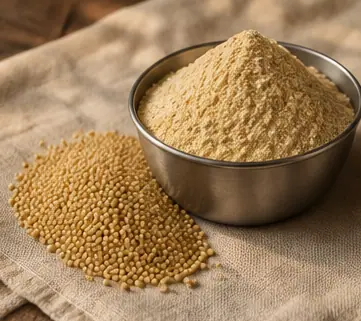
The story of Foxtail millet
Foxtail millet was first farmed in northern China. Reviews place its domestication roughly 7,400 to 7,900 years ago in the Yellow River Valley, at early village sites such as Cishan and Peiligang. Its wild ancestor is green foxtail, Setaria viridis, a grass that still grows as a weed. For thousands of years it was a staple of northern China, long before rice or wheat took over.
From there it travelled. Historians describe foxtail spreading west into Europe and south into India soon after domestication, carried as a crop that thrives on poor soils and little water. By the time written history begins it was already grown across Asia. In India it settled into the dry belts of Karnataka, Andhra Pradesh, Rajasthan, Madhya Pradesh, Chhattisgarh and Tamil Nadu, and it has local names in nearly every language: kangni, navane, tenai, korralu.
Kangni mills fine and plays nicely.
Over the last century it faded, in India and in China, as higher-yielding crops took over and demand dropped. An ICAR article notes that foxtail millet is now grown on a limited area, mostly to meet the home needs of rural families. That is a pity, because it is one of the easiest millets to cook with: its flour is fine, golden and mild, with none of the bitterness some millets carry.
We use foxtail in small shares, around 10 percent, in our lighter blends. It adds a fine texture and a gentle nutty note without changing the roti much, and it is a good first millet for family members who are suspicious of anything new.