The Farm Flour

Where should we deliver?

Your pincode sets your city, cutoff and delivery slots across the site.

Bajra

The hardy, earthy millet of Rajasthan, and India's great winter roti.

  • Pearl millet
  • Bajri (Marathi, Gujarati)
  • Sajje (Kannada)
  • Pennisetum glaucum
  • बाजरा · సజ్జలు · ಸಜ್ಜೆ
Botanical name
Pennisetum glaucum
Origin
West Africa (the Sahel)
Grown mainly in
Rajasthan, Maharashtra, Uttar Pradesh, Haryana, Gujarat
Season
Monsoon (kharif)
Gluten
No gluten of its own (milled on shared equipment)
Flavour
Earthy, robust, slightly sweet

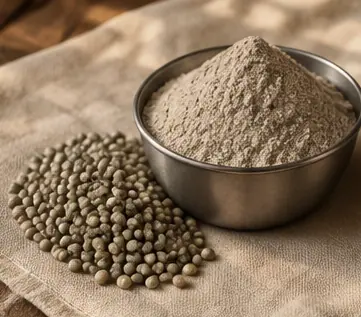
Bajra is the grain of dry country: tough, earthy and full of character. It grows where little else will, and it has fed Rajasthan, Gujarat and Haryana through hot summers and cold winters. The flavour is robust and the roti is a winter favourite, eaten with ghee and jaggery.

The story of Bajra

Pearl millet was first domesticated in West Africa, in the Sahel, around 4,000 to 5,000 years ago. It reached India early: archaeological evidence suggests it was already here by about 2000 BCE, and it adapted to the subcontinent's driest corners.

India is now the world's largest producer of pearl millet, with almost a third of global output, according to an article in the ICAR journal Indian Farming. Rajasthan, Maharashtra, Uttar Pradesh, Haryana and Gujarat together grow about 90 percent of it. A peer-reviewed review by Jukanti and colleagues notes pearl millet's strong tolerance of drought and high temperature, and its ability to grow on poor, marginal soils where other cereals fail.

Bajra is a winter grain. It likes ghee and company.

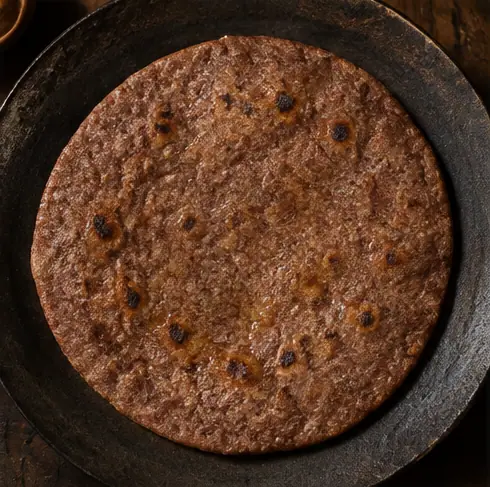
That resilience made it a food security grain long before the phrase existed. In Rajasthan it is the bajre ki roti, thick and rustic, eaten with white butter, garlic chutney, or the famed ker sangri. In Gujarat it is the bajri no rotlo with jaggery and ghee. In Haryana and Punjab it turns up as khichdi with moong dal. Across all of north-west India it is traditionally a winter grain.

Bajra is also the oiliest of the common millets, with more fat than jowar or ragi. That is part of its rich taste, and also why fresh milling matters so much: bajra flour left on a shelf turns stale and bitter faster than most. It is one more reason we mill to order.
What Bajra brings to your plate

  • Rich in minerals

    Published tables put bajra around 6 to 8 mg of iron per 100 g, higher than most common cereals, along with magnesium and zinc. It is non-haem (plant) iron, which absorbs better when eaten with a vitamin C source such as lemon on the side.

  • Fibre and protein

    Typical values are about 11 g of protein and 11 to 12 g of dietary fibre per 100 g (IFCT 2017).

  • Naturally robust flavour

    The earthy, nutty taste is the point: it is what makes bajra rotis and khichdi taste like Rajasthan.

  • No wheat

    Bajra has no gluten of its own and is wheat-free, though ours is milled on shared equipment.

  • A grain for tough climates

    Pearl millet is one of the most heat- and drought-tolerant cereals, so cooking with it supports crops suited to a warming world.

Values are typical for the grain, from the Indian Food Composition Tables (IFCT 2017) and published reviews, and vary by variety and harvest. Food information, not medical advice.

Nutrition per 100 g

Typical nutrition per 100 g of Bajra flour
Energy348 kcal
Protein11 g
Carbohydrate61.8 g
Fat5.4 g
Dietary fibre11.5 g
Calcium27 mg
Iron6.4 mg

Source: draft values pending exact IFCT 2017 figures and nutritionist sign-off. Typical values, vary by harvest. Food information, not medical advice.

Bajra in your kitchen

How the dough behaves

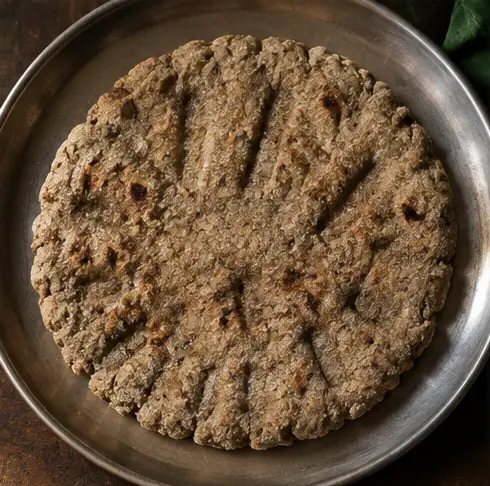
Bajra dough is short and does not stretch. Use warm to hot water, add it slowly, knead until it holds together, then pat it into a thick disc rather than rolling it thin.

Tips

  • Blend with 40 percent or more wheat if you want to roll it.
  • Use a pinch of salt and a little oil in the dough for flexibility.
  • Cook on a hot tawa and finish over the flame.
  • Serve warm with ghee: bajra is at its best fresh.

What to cook

  • Bajre ki roti and bajri no rotlo
  • Bajra khichdi
  • Bajra thepla and dhebra
  • Bajra porridge (raab)

Pairs well with

  • Jowar
  • Ragi
  • Sharbati
  • Ghee, jaggery, garlic chutney

Storing it

Higher in fat than other millets, so it goes stale faster. Keep airtight and cool, or in the fridge, and use within a couple of weeks.

Allergens: no major allergen of its own. Milled on shared equipment that also handles wheat (gluten), barley, oats and chickpea.

Where you will find Bajra in our flours

  • Red Earth

    Rich in the old grains.

    Rolls like a phulka · 6.9 g fibre, 6.2 g protein per 2 rotis

    Make it yours
  • The Old Grain

    What your grandmother ate, milled this morning.

    Wheat-free, milled on shared equipment.

    Bhakri style: pat, do not roll · 6.6 g fibre, 6.6 g protein per 2 rotis

    Make it yours

Bajra: your questions

Is bajra the same as pearl millet?

Yes. Bajra is the Hindi name for pearl millet (Pennisetum glaucum).

Does bajra contain gluten?

Bajra has no gluten of its own, but our flours are milled on shared equipment that also handles wheat, barley and oats, so we do not recommend them for coeliac disease or a gluten allergy.

Why is bajra called a winter grain?

In north-west India, bajra roti with ghee, jaggery or butter is traditionally a cold-season food. It is grown in the monsoon and eaten through the winter.

Why does bajra flour go stale quickly?

Bajra has more fat than other common millets, and fat turns rancid on storage. Fresh milling and airtight, cool storage keep it tasting good.

Which state grows the most bajra?

Rajasthan is the largest producer, followed by states such as Maharashtra, Uttar Pradesh, Haryana and Gujarat, which together make up about 90 percent of India's pearl millet.

Sources and further reading

Last updated 23 October 2026. Not yet reviewed by a nutritionist.

From the Journal

Explore other grains

Your cart

The Farmer