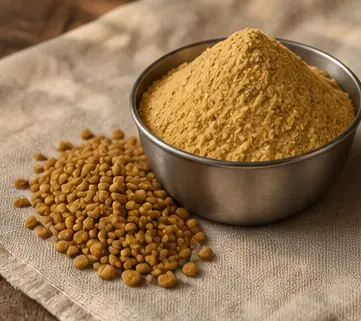
The story of Methi seed powder
Fenugreek is an annual legume native to a belt stretching from Iran to northern India. It is one of the oldest cultivated spices: charred seeds from Tell Halal in Iraq are dated to about 4000 BCE, and fenugreek is reported in Egyptian tombs from around 1500 BCE. India has used it for a very long time, in food and in traditional practice.
Today India is among the world's main producers. Its seeds and leaves are everyday ingredients in the Indian subcontinent. The leaves, fresh or dried as kasuri methi, flavour curries and parathas. The seeds are toasted into tadkas, ground into spice blends like sambar powder and panch phoron, pickled with mango and lemon, and kneaded into Gujarati thepla.
Methi is a pinch, not a portion.
Methi's character is its bitterness, and Hinduism Today's column on the spice says it plainly with the title Bitter Is Better. The same seed gives off a sweet, maple-like aroma when toasted, caused by a compound called sotolon. Cooks learn quickly how much to use: too little and you taste nothing, too much and the dish is bitter.
In flour, the same rule applies. A pinch of methi seed powder, no more than 3 percent, adds a savoury depth to a roti, much as a Gujarati thepla does. Because it is so strong, we treat it as a booster and do not include it in the Studio's grain list yet.