The story of Besan
The chickpea is one of the oldest cultivated legumes. It most likely began in what is now south-eastern Turkey and northern Syria, and archaeological finds date its use to at least 5000 BCE in the region. From there it travelled through Central Asia and the Middle East into the Indian subcontinent, where it found ideal conditions and a cuisine ready to use it.
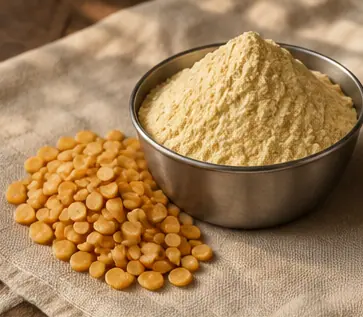
India is today the chickpea's greatest stronghold. In 2022 it accounted for about 75 percent of the world's chickpea production, roughly three quarters of the global crop. Most of it is the small, angular, dark desi type, as opposed to the pale, plump kabuli chickpea you see in hummus. Skin off and split, the desi chickpea becomes chana dal, and ground, it becomes besan.
Besan is the softness secret your mother-in-law knows.
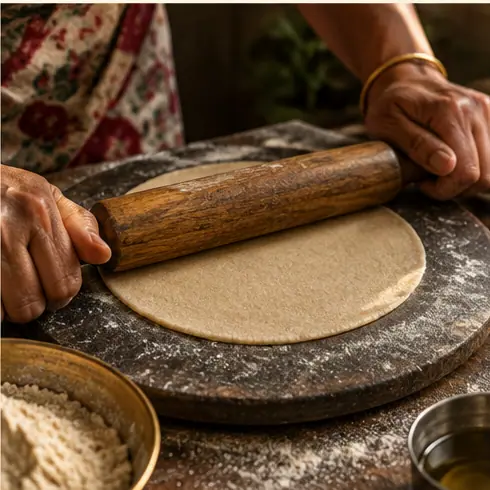
Besan is the backbone of Indian snacking: pakoras and bhajiyas, kadhi, dhokla, sev and bhujia, laddu and mysore pak. In Punjab, besan goes into missi roti, where it is kneaded into wheat dough with onion, chilli and ajwain for a roti with more flavour and protein. In Gujarat and Rajasthan, besan rotis, gatte and cheela are everyday food, and across India the batter cheela, or pudla, is a quick breakfast.
For our blends, besan plays a supporting role. A small share, 5 to 15 percent, makes a roti noticeably softer and keeps it tender for hours, which is why mothers and mothers-in-law have always added a handful. It is also the main source of protein in The Long Run.